Trane Furnace Repair in West Covina
The straight version: West Covina Trane HVAC repairs Trane gas furnaces across West Covina, CA - XR80, S8 80 percent and S9V2 / XC95m high-efficiency units in Woodside Village, Cameron Park and South Hills within 91790 through 91793 - diagnosed by control-board LED flash code, so call (213) 444-4051 or book online for an out-of-warranty no-heat repair.
Plain facts
- Furnace lines serviced: 80 percent XR80 / XL80 / S8; 95-97 percent XR95 / S9X2 / S9V2; modulating XC95m.
- Common parts: hot-surface igniter, flame sensor, inducer motor, pressure switch, high-limit, gas valve, control board.
- Diagnosed by integrated furnace control LED flash code (2 lockout, 3 pressure, 4 limit, 8 flame, 9 igniter).
- Typical furnace repair $150 to $900 depending on part.
- Mild Zone 9 winters make 80 percent furnaces adequate for most homes here.
- We red-tag genuinely unsafe furnaces (cracked heat exchanger) rather than patch them.
- Service area: West Covina (91790-91793). Independent; in-warranty units to authorized service first.
- Diagnostic $79 to $200, credited toward repair.
How do you diagnose a no-heat Trane furnace?
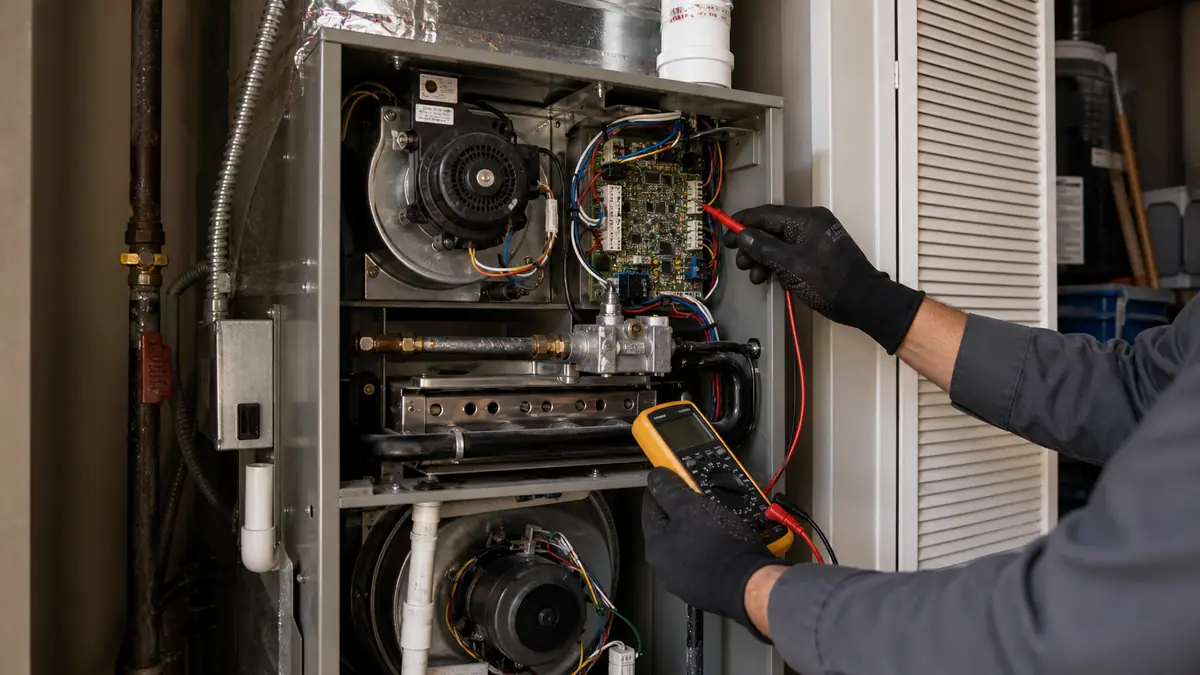
The Trane integrated furnace control tells the story before tools come out. Through the sight glass, the amber or green status LED blinks its own shorthand: a slow blink just means the board is idle, a quick blink means it has a live heat call, a repeating pattern names the fault, and a steady glow that never blinks means the board itself has died. We read it, then test the named component. Most West Covina no-heat calls come down to the ignition train - a worn hot-surface igniter (9 flashes, igniter circuit), a dirty flame sensor that fails to prove flame (8 flashes, low flame sense), or a pressure switch that will not close because the inducer or flue is restricted (3 flashes).
| Flash code / symptom | Likely cause / first check | Component | Cost lane |
|---|---|---|---|
| 8 flashes - lights then drops out | Weak flame current, clean or replace sensor | Flame sensor | $150 - $300 |
| 9 flashes - no ignition | Cracked or weak igniter, igniter circuit | Hot-surface igniter | $200 - $450 |
| 3 flashes - inducer runs, no light | Switch will not close, blocked flue or hose | Pressure switch / inducer | $200 - $600 |
| 4 flashes - heats then shuts off | Overheat on low airflow, dirty filter or ducts | Open high-limit switch | $150 - $700 |
| 7 flashes - no gas at burners | Gas valve circuit or valve itself | Gas valve | $300 - $900 |
| 2 flashes - system lockout | Retries exceeded, root-cause one of the above | Varies; full diagnosis | $150 - $900 |
How does a Trane furnace repair actually go?
On a West Covina furnace we let the ignition sequence itself point to the fault rather than guessing at parts. We power-cycle a heat call and watch the sequence: the inducer should spin up and close the pressure switch, the igniter should glow, the gas valve should open, and the flame sensor should prove flame within the trial-for-ignition window. Wherever the sequence stalls is where the fault lives, and the flash code confirms it. From there we meter the named part - flame current in microamps on the sensor, resistance and continuity on the igniter, the pressure switch's make/break against inducer draft, and 24V at the gas valve.
For a 4-flash high-limit trip we step back to airflow, because the heat side is usually fine: filter condition, blower-wheel cleanliness, and the static pressure across the leaky 1960s duct runs that starve return air. On a communicating system we also read the XL824 or XL850 plain-language alert. Before we hand the furnace back we run a full heat cycle, confirm temperature rise is within the nameplate range, and inspect the heat exchanger - any crack or rollout evidence stops the repair and gets the unit red-tagged. Tools: combustion-safe meter, manometer for the pressure switch, microamp meter for flame sense, and a thermometer for temperature rise.
Why do West Covina furnaces trip the high-limit?
A 4-flash open high-limit almost always traces to airflow, not the heat side. A clogged filter, a dirty blower wheel, or the leaky undersized ducts common in 1960s tract homes starve the furnace of return air, so the heat exchanger overheats and the limit cuts the gas to protect it. We check filter and blower first, then measure static pressure and look at the duct system. The same airflow restriction shows up in summer as weak airflow from the vents and can ice the AC coil - one root cause, two seasonal symptoms.
What does furnace repair cost in West Covina and why?
Furnace repair in West Covina runs $150 to $900, and the part sets the lane. The cheapest and most common is a flame-sensor clean or swap (8 flashes), often $150 to $250, because the part is inexpensive and the labor is light. Mid-range are the ignition and draft parts - a hot-surface igniter (9 flashes), a pressure switch or an inducer motor (3 flashes) - where the part cost climbs. The high end is a gas valve (7 flashes) or a control board behind a recurring 2-flash lockout, plus any repair that uncovers a deeper safety problem. Because West Covina runs mild Zone 9 winters, we will tell you when a few-hundred-dollar repair on an 80 percent furnace beats a several-thousand-dollar replacement.
When is replacement the safer call?
We patch ignition and airflow faults all day, but a cracked or rusted-through heat exchanger is a carbon monoxide risk - a 6-flash polarity fault, a rollout trip, or visible exchanger damage gets the furnace red-tagged, not band-aided. On an older 80 percent unit at that point, a new high-efficiency Trane furnace or heat pump is the honest recommendation, and a heat-pump conversion may pull a rebate that a furnace will not. Pair a high-efficiency S9V2 with a matched AC install if both halves are aging out, so the charge and airflow verify cleanly as one job.
Common questions
My Trane furnace clicks and the burners light then shut off. What is that?
Classic weak flame sense - the control board lights the burners, fails to prove flame within a few seconds, and shuts the gas. The integrated furnace control usually shows 8 flashes. Cleaning or replacing the flame sensor fixes most of these for well under $250.
What do the furnace LED flashes actually mean?
Count the blinks on the control board through the sight glass: 2 is a lockout after failed retries, 3 is a pressure-switch or inducer fault, 4 is an open high-limit from low airflow, 7 is the gas-valve circuit, 8 is low flame sense, 9 is the igniter circuit. We read the code first, then test the named part.
Is it worth fixing an old 80 percent furnace in West Covina?
Usually yes. Zone 9 winters are mild, so an 80 percent Trane XR80 or S8 is adequate, and an igniter or pressure switch repair is a few hundred dollars versus thousands to replace. We only push replacement when the heat exchanger is compromised - a safety issue, not an upsell.
When does a furnace problem become a carbon monoxide concern?
A 6-flash polarity fault or any sign of a cracked heat exchanger means we stop and protect you. A rollout trip or a repeated limit trip can point to exchanger trouble; we red-tag a genuinely unsafe furnace rather than patch it.
Why won't my furnace blower shut off after the heat cycle?
Usually the fan limit control or the board's fan-off timing, not the blower itself. A continuously running blower can also mean the limit opened on overheating and the board is purging heat. We check the limit, the board settings, and airflow before replacing anything.
How much does a typical West Covina furnace repair cost?
Most run $150 to $900. A flame-sensor clean is the cheap end near $150 to $250; an igniter, pressure switch, or inducer is mid-range; a gas valve or control board with a recurring lockout sits toward $900. The diagnostic ($79 to $200) is credited toward the repair if you approve it that visit.