Trane Maintenance Calendar for West Covina
Last updated 2026-06-13. Tuned to Title-24 Climate Zone 9 and West Covina's heavy summer cooling load.
The straight version: This Trane maintenance calendar for West Covina, CA gives a month-by-month schedule tuned to Zone 9 heat - filters, coil cleaning and a spring tune-up - so Galaxie and South Hills (91790) homeowners avoid a July breakdown; call West Covina Trane HVAC at (213) 444-4051 or book online for the pro steps. We are independent.
Plain facts
- Filter change: every 1 to 3 months, shorter near the freeway corridor or in heavy use.
- Best tune-up window: spring (March-April), before the first heat wave.
- Zone 9 means 55-75 days a year at or above 90 F - heavy, sustained cooling load.
- DIY-safe: filters, clearing debris and weeds from the condenser, gentle coil rinse (power off).
- Leave to a tech: refrigerant charge, capacitor / contactor testing, fin straightening, electrical.
- Most common preventable failure here: a weak capacitor caught before it stalls the compressor.
- Service area: West Covina (91790-91793). Independent.
- Diagnostic $79 to $200, credited toward any repair found.
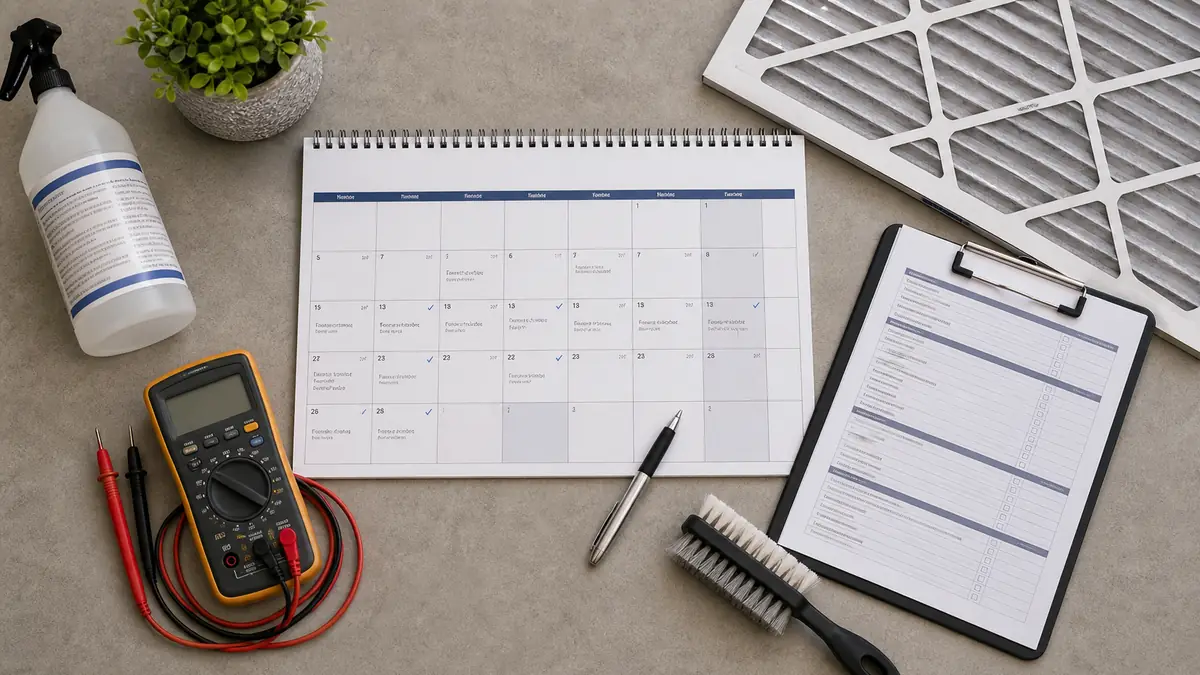
What does a West Covina maintenance year look like?
West Covina's calendar is cooling-driven. The Zone 9 summer is long and hard, so the goal is to enter June with a clean coil, a verified charge, and a healthy capacitor - the part most likely to leave you with a humming, no-cool condenser on a 96 F afternoon. Heating is the lighter season here, so the fall furnace check is quicker. Here is the rhythm we recommend.
| Season | Do this | Who |
|---|---|---|
| Spring (Mar-Apr) | Pro tune-up: coil clean, charge check, capacitor / contactor test before summer | Technician |
| Late spring | Clear weeds and debris from the condenser; gentle coil rinse, power off | DIY |
| Summer (Jun-Sep) | Change filter monthly under heavy use; watch for ice or weak airflow | DIY |
| Fall (Oct-Nov) | Furnace check: igniter, flame sensor, pressure switch, flue; test the heat once | Technician |
| Winter (Dec-Feb) | Replace filter; confirm thermostat schedule; listen for furnace flash codes | DIY |
What is the month-by-month Trane schedule for West Covina?
Zone 9 runs a long cooling season and a short, mild heating one, so the calendar front-loads everything into late winter and spring to be ready before the first 95 F stretch, then shifts to light monitoring through the summer. Here is the month-by-month version we hand West Covina homeowners, with the task and whether it is a homeowner job or a tech job.
| Month | Task | Who |
|---|---|---|
| January | Mid-winter filter swap; run the heat once and confirm no furnace LED flash code (2 lockout, 3 pressure switch, 4 limit); check the thermostat schedule. | DIY |
| February | Clear leaves and Santa Ana debris off the condenser top and coil; confirm the disconnect and breaker are tight; book the spring tune-up before the March rush fills up. | DIY + book |
| March | Pro tune-up: microfarad-test the dual-run capacitor against the nameplate, meter the contactor, wash the Spine Fin coil, verify refrigerant charge and superheat before the heat arrives. | Technician |
| April | Fresh 1-inch pleated filter for the cooling season; gentle inside-out coil rinse with the breaker off; clear two feet around the outdoor unit for airflow. | DIY |
| May | First real heat test: run cooling and confirm a 16-22 F split between return and supply air; if the split is weak, call before June load exposes a low charge. | DIY + watch |
| June | Start monthly filter checks; pour a cup of vinegar down the condensate line to keep the drain clear; watch for any ice on the line set or weak airflow. | DIY |
| July | Peak load - change the filter, keep registers and returns clear of furniture, and do not run a unit that is humming with a dead fan (a stalled capacitor cooks the compressor). | DIY |
| August | Mid-summer filter swap; rinse road dust off the coil if you are near the 10 in Vincent; listen for new rattles, buzzes or screeches and address them early. | DIY |
| September | Late-heat filter check; the season is not over in Zone 9, so keep cooling maintenance going; note any rooms that ran weak so ducts can be addressed in fall. | DIY |
| October | Fall furnace check: inspect the hot-surface igniter and flame sensor, test the inducer and pressure switch, confirm the flue is clear, and run one full heat cycle. | Technician |
| November | Switch to a fresh filter for heating; confirm the thermostat heat schedule; if ducts ran leaky all summer, this is the slow-season window to seal them with a HERS test. | DIY + book |
| December | Replace the filter; keep the outdoor unit clear in case of a winter Santa Ana; verify carbon-monoxide alarms work if you run a gas furnace. | DIY |
The pattern is deliberate. Two technician visits anchor the year - a spring cooling tune-up in March and a fall furnace check in October - and everything in between is the homeowner keeping airflow clean and the drain clear. In a coastal climate you could skip half of this; in West Covina's sustained inland heat, a clogged filter in July is the difference between a steady cycle and an iced coil.
What does skipping maintenance actually cost in West Covina?
Run the numbers on a typical Galaxie ranch. A spring tune-up catches a capacitor that has drifted from a nameplate 45 microfarads down to 38 - a part that costs $150 to $450 installed and ten minutes of labor. Skip the tune-up and that weak capacitor stalls the Climatuff compressor on the first 96 F afternoon; now the locked-rotor current has overheated the windings, and you are weighing a $1,200 to $3,500 compressor against a full replacement. The same logic runs through the system: a $20 filter prevents a frozen coil; a $250 coil cleaning prevents a system running 20 percent hotter all summer; a one-time duct seal stops conditioned air bleeding into a 130 F attic. Maintenance is not insurance you hope you never use - in Zone 9 it pays back every single cooling season.
| Issue | Caught at maintenance | Left until it fails |
|---|---|---|
| Weak capacitor | $150 - $450 capacitor | $1,200 - $3,500 compressor |
| Dirty filter / coil | $20 filter / $250 coil clean | $225 - $1,500 frozen-coil and charge work |
| Clogged condensate drain | Free vinegar flush | $150 - $450 plus attic water damage |
| Leaky 1960s ducts | $800 - $3,100 sealing once | Years of high bills and weak back rooms |
Why is the spring tune-up the one that matters most here?
Because the failures that strand West Covina homeowners are heat-driven, and they hit first on the hottest days. A capacitor that tests weak in April will stall the Climatuff compressor under July load; a coil left dirty through spring forces the system to run hotter and longer until it ices or trips. A spring visit catches all of that while you are not in a no-cool emergency. It is also when we verify the Spine Fin coil is clean and the charge is correct - the two things that determine whether the system sails through summer or short cycles and freezes.
What can I safely do myself, and what needs a tech?
Homeowner-safe tasks are mechanical and low-risk: change the filter, keep the outdoor unit clear of weeds and the dust the Santa Ana winds drop, and rinse the condenser coil gently from the inside out with the breaker off. What needs a tech is anything involving refrigerant, electrical, or the delicate Spine Fin fins: charge checks, capacitor and contactor testing (the cap holds a dangerous charge), fin straightening, and reading ComfortLink alerts. The dividing line is simple - if it can shock you, slug your compressor, or void a warranty, it is ours.
Does the maintenance change by Trane tier?
It does, because the three Trane tiers have different things to watch. A value single-stage XR is mechanically simple: the spring tune-up focus is the capacitor, contactor, charge, and the Spine Fin coil, with little electronics to fuss over. An XL18i two-stage adds a second stage and staging controls, so we verify it is actually dropping to low stage rather than running high all the time - a stuck stage quietly raises the bills it was bought to lower. A variable-speed XV20i carries the most electronics: the inverter drive, the communicating board, and the ComfortLink II XL850 or XL824 control. On those we read the thermostat for any stored plain-language alert, confirm the 4-wire communication run to the outdoor unit is solid, and check the ECM blower module - because a communicating system surfaces faults you would otherwise miss until it stops. More technology means more comfort and lower bills, but also a slightly longer checklist at tune-up time.
One constant across all three tiers: the capacitor and the coil. In West Covina's sustained Zone 9 heat those are the two things most likely to strand you, so every spring visit, regardless of tier, starts there.
Does maintenance change by neighborhood?
A little. Homes in Vincent near the 10 freeway load filters and coils faster from road dust, so they earn the shorter filter interval. Two-story South Hills estates with variable-speed XV20i systems have more electronics to keep an eye on but tend to run cleaner and steadier. Across the board, the leaky 1960s tract ducts are worth a one-time inspection - sealing them is maintenance that pays back every summer.
Common questions
How often should I change my filter in West Covina?
Every 1 to 3 months, and on the shorter end if you live near the 10 freeway in Vincent or run the AC hard through a Zone 9 summer. A 1-inch pleated filter loads up faster than most homeowners expect, and that choked filter is the first thing we find behind the weak-airflow and frozen-coil calls that come out of this part of the valley.
When is the best time to get a pre-season tune-up?
Spring, before the first real heat wave. Booking a coil cleaning, charge check and capacitor test in March or April beats waiting for the July rush when a dead capacitor leaves you sweating in line behind every other West Covina home.
Can I clean my own Trane condenser coil?
Light rinsing with a gentle hose from the inside out is homeowner-safe with the power off. Leave chemical coil cleaners, fin straightening, and anything involving refrigerant or electrical components to a tech - the Spine Fin coil bends easily and the capacitor holds a charge.
Does a maintenance plan really extend a Trane's life?
Catching a weak capacitor, low charge, or dirty coil before it cascades genuinely prevents bigger failures - a stalled compressor from a dead capacitor, or a burned ECM module. It will not make a 16-year-old unit immortal, but it buys years on a healthy one.