Frozen Trane Evaporator Coil in West Covina
The straight version: A frozen Trane evaporator coil in West Covina, CA almost always means low refrigerant or restricted airflow, so call West Covina Trane HVAC at (213) 444-4051 or book online to diagnose which across Vincent, Galaxie and South Hills (91793) before the ice damages the compressor. We are independent.
Plain facts
- A coil freezes when it runs below 32 F and humidity condenses and ices over.
- Two main causes: low refrigerant (Spine Fin / line-set leak) and airflow restriction (filter, coil, blower).
- Less common: a stuck TXV starving the coil.
- First move: system off, fan on, to melt the ice safely in 1-2 hours.
- Running a frozen system can slug liquid back to the Climatuff compressor - costly damage.
- Leak repair $225 to $1,500; coil / filter airflow fix $150 to $500.
- We also clear the condensate drain so the melt does not flood the attic.
- Service area: West Covina (91790-91793). Independent.
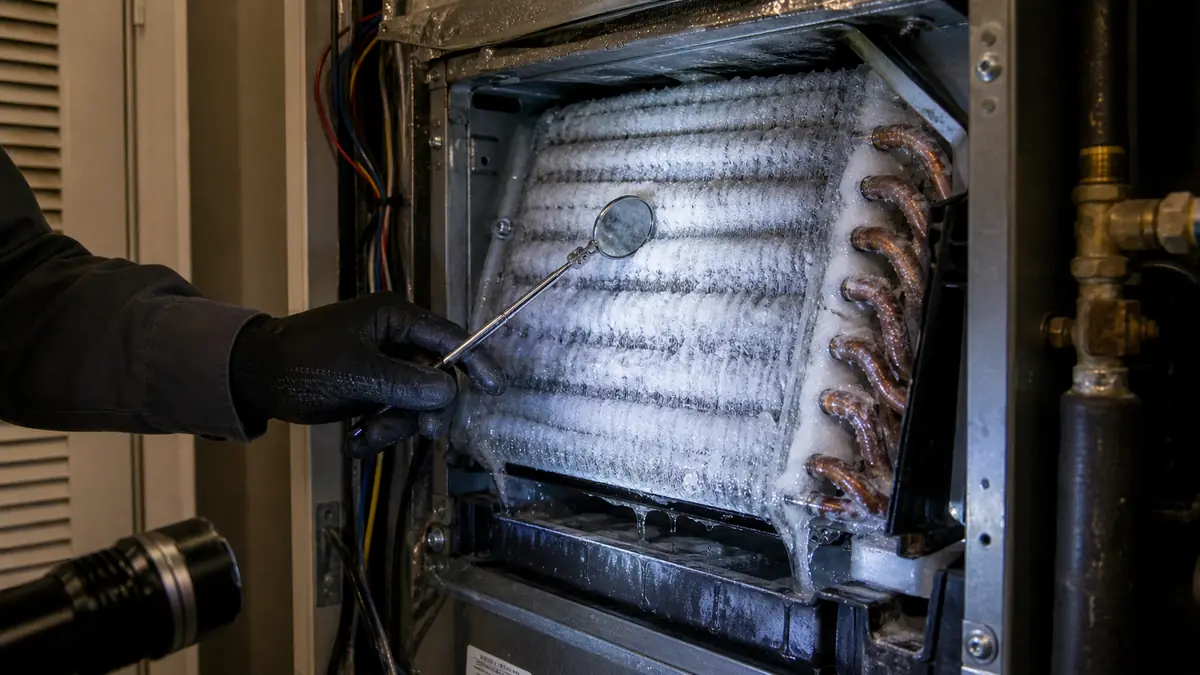
Why does a Trane coil freeze in the West Covina heat?
It feels backwards - ice in a 96 F Zone 9 summer - but the physics are simple. The evaporator coil is supposed to run cold; when refrigerant is low or airflow is restricted, the coil surface drops below 32 F and humidity in the return air freezes onto it. The harder the system runs on a hot afternoon with a weak charge or a dirty coil, the faster a thin layer of frost becomes a solid block of ice that blocks airflow entirely and turns into weak or no airflow.
| Symptom pattern | Likely cause / first check | Cost lane |
|---|---|---|
| Ice, weak air, worse over time | Low refrigerant leak; charge and superheat | $225 - $1,500 |
| Ice after a missed filter change | Restricted airflow; replace filter, clean coil | $150 - $500 |
| Ice plus a failing blower | Weak / failed ECM blower motor | $450 - $2,300 |
| Ice with normal charge and airflow | Stuck or clogged TXV | $350 - $900 |
| Water in attic after melt | Clogged condensate drain / failed pan | $150 - $450 |
What should I do the moment I see ice?
Set the system to off and the fan to on. The blower moving room-temperature air over the coil melts the ice in an hour or two without you chipping at delicate aluminum fins. Do not keep running it in cool mode - that risks liquid refrigerant slugging back to the Climatuff compressor, which turns a $250 airflow fix into a four-figure compressor job. Once it is thawed, swap the filter; if it ices again, it is a charge or airflow problem that needs gauges.
How does a tech diagnose a frozen Trane coil step by step?
Diagnosis starts only after the ice is gone, because gauges read nothing useful on a frozen system. We thaw it with the fan running, then work the two big buckets in order. Airflow first: filter, return, supply registers, blower operation, and a static-pressure reading to expose a restriction or a weak ECM blower. Then refrigerant: gauges on the service ports, reading superheat and subcooling against the charging chart. A low charge with high superheat points to a leak - and on ductless or line-set joints the leak is often at a flare or the Spine Fin coil itself. If airflow and charge both read normal but the coil still ices, the suspect is a stuck or clogged TXV starving the coil. We confirm the leak point with an electronic detector or bubbles before condemning a part.
Trane central units are largely non-communicating, so there is no numeric freeze code - the air-handler or furnace may show a 4-flash high-limit trip when low airflow overheats it, but the real diagnosis is the charge and airflow readings. A communicating XV system will flag an alert on the XL850, which narrows it faster.
What can I safely do, and what needs a pro?
Homeowner-safe: switch the system off and the fan on to thaw it, then replace the filter and clear blocked registers and returns. That is the full safe list. Everything else on a frozen coil needs a pro, because the two real causes both require instruments - a refrigerant charge and superheat check needs gauges and EPA certification to handle R-410A, and a leak search, TXV test, or blower diagnosis needs training. Do not chip at the iced fins; the all-aluminum Spine Fin bends easily, and do not keep running it in cool mode while it thaws, which risks slugging liquid back to the Climatuff compressor. A frozen coil also rarely travels alone: the same low charge that ices the coil drives short cycling, and the restriction behind it is often the leaky attic ductwork common in 1960s tract homes. If a leak keeps recurring on an older Spine Fin coil, a replacement may beat repeated recharges.
Common questions
Should I turn the AC off if the coil is frozen?
Yes. Switch the system to off and the fan to on - running the blower with cooling off melts the ice in an hour or two without running water everywhere. Running a frozen system risks slugging liquid refrigerant back to the Climatuff compressor, which is expensive damage.
Why does my Trane coil freeze when it is 95 F outside?
Counterintuitive but common: under peak Zone 9 load a low charge or restricted airflow drops the coil below freezing and humidity ices it. The hotter and harder the system works on a weak charge or dirty coil, the faster it frosts over.
Is a frozen coil always low refrigerant?
No. The two big buckets are low refrigerant (a Spine Fin or line-set leak) and airflow restriction (dirty filter, dirty coil, weak blower, closed vents). A stuck TXV is a third, less common cause. We confirm which with gauges and an airflow check, not a guess.
Will a frozen coil leave water in my West Covina attic?
It can. When the ice melts, a clogged condensate drain or a failed pan can overflow into the attic or ceiling. We clear the drain and check the float switch while diagnosing the freeze so a melt does not become water damage.