Trane Furnace 3 Flashes in West Covina, CA
The straight version: A Trane furnace 3 flashes in West Covina, CA (ZIP 91790) means a vent or pressure-switch error: the inducer did not prove draft, so the board halts ignition for safety; call West Covina Trane HVAC at (213) 444-4051 or book online and we test the draft on your unit. We are independent.
Plain facts
- 3 flashes on a Trane integrated furnace control = a vent/pressure-switch fault: the pressure switch did not close (or reopened) during the draft-proving step.
- Usual causes: blocked flue, weak or failing inducer, cracked or disconnected sensing tube, plugged condensate trap.
- The pressure switch is a safety - it confirms the inducer is pulling combustion gases out before the burners light.
- First check: flue/vent clear, sensing tube on its port, condensate trap not plugged.
- Costs here: a draft clearing inside a $79 to $200 visit; pressure switch about $150 to $350; inducer about $300 to $700.
- Never jumper the pressure switch to force a run - that defeats a combustion-safety check.
- Service area: West Covina (91790-91793) - South Hills, Galaxie, Woodside Village, Merlinda, Vincent.
What does a Trane furnace 3 flashes mean?
Three flashes on the LED behind your Trane furnace's lower door is the control board saying it could not prove draft. Before any Trane gas furnace lights its burners, the inducer motor spins up and pulls a small vacuum through the heat exchanger and flue. A pressure switch - basically a calibrated diaphragm - is supposed to sense that vacuum and close its contacts within a few seconds, telling the board "exhaust is moving, safe to fire." When that switch does not close, or closes and then reopens mid-cycle, the board counts three flashes and refuses to open the gas valve. That refusal is the whole point: it guarantees the furnace will not burn gas unless the combustion byproducts are actually leaving the house. So a 3-flash is rarely a "broken pressure switch" on its own - it is the switch reporting that something upstream of it is wrong, and the diagnostic job is to find what.
Why does a Trane throw 3 flashes in West Covina homes?
West Covina's pattern is specific, and it comes down to climate and housing stock. We sit in Title-24 Climate Zone 9 on the eastern edge of the San Gabriel Valley, where summers are long, hot and dry - July highs around 92 to 96 F - and the heating season is short. A furnace that idles from April to November dries out, collects valley dust, and gives spiders and debris months to colonize a flue cap. The post-war minimal-traditional and ranch homes across Galaxie, Merlinda and Vincent commonly have furnaces tucked in a closet or a low attic with the original flue run, and those older B-vents pick up nests and screen blockages that choke draft. Newer high-efficiency furnaces in the Spanish-style South Hills hillside homes use PVC intake and exhaust that runs to a sidewall - those clog differently, often with a condensate trap that dried out over summer and crusted shut, or a sensing tube that hardened and cracked in attic heat. Either way, the first genuinely cold morning loads the draft path for the first time in months, and that is when the 3-flash calls land.
How do you diagnose a 3-flash Trane step by step?
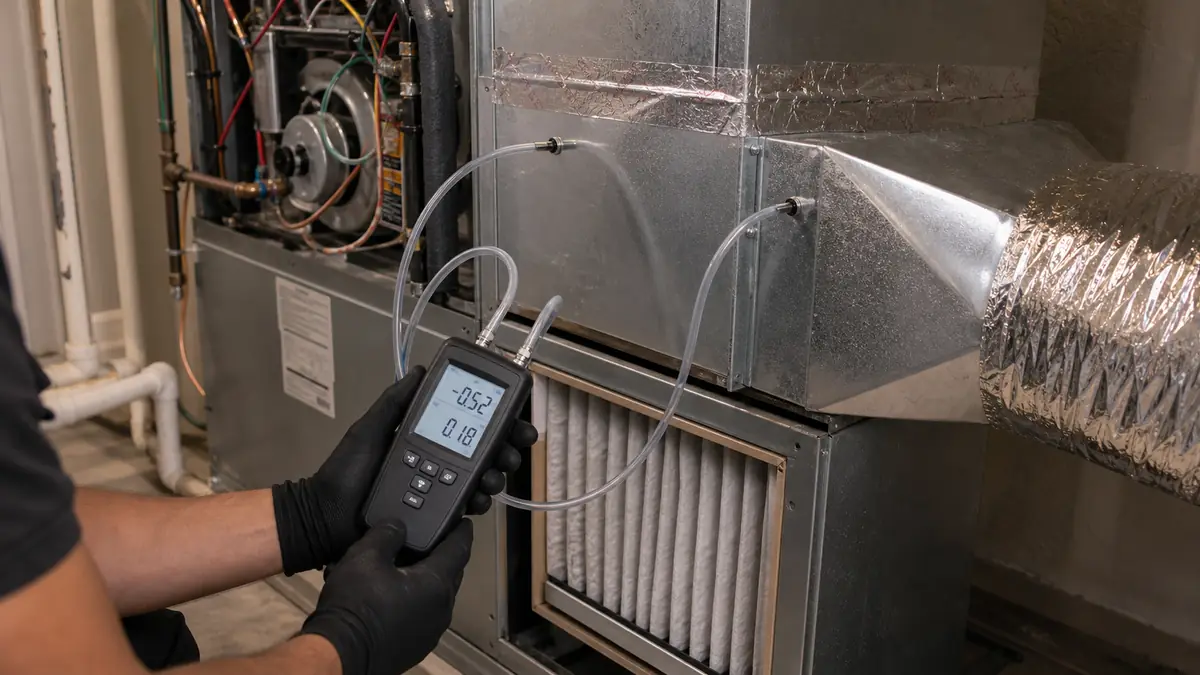
We work the draft path in order, cheapest and likeliest first, and every step is a real reading, not a guess. First we confirm the code by counting the LED twice through the sight glass. Then we put the furnace into a call for heat and watch the inducer: does it spin up strong, weak, or wobble and rattle? A weak inducer cannot pull enough vacuum to close the switch. Next we pull the tubing off the pressure switch and put a manometer on the inducer port to read the actual vacuum in inches of water column, comparing it to the switch's stamped set point - that single reading separates a bad switch from a weak inducer from a blockage. We inspect the sensing tube for cracks, kinks, and condensate pooling, and reseat it on its port. We check the flue or PVC vent end to end for nests, screen blockage, sagging that traps water, and on condensing units a plugged condensate trap or a backed-up drain that floods the collector box. We also meter the switch itself: continuity when vacuum is present, open when it is not. If the vent is clear, the tube is sound, the trap is open, and the inducer pulls its rated vacuum but the switch still will not close, then - and only then - the switch is the failed part.
What can I safely check before calling a pro?
There are a few homeowner-safe checks that occasionally clear a 3-flash for free. Replace a heavily clogged filter, because severe airflow restriction can disturb draft on some setups. Walk outside and look at the flue or sidewall vent termination for an obvious bird nest, wasp nest, or debris you can clear by hand with the power off. On a high-efficiency furnace, check whether the condensate drain line is backed up or the trap is dry and crusted. Try exactly one power-cycle reset at the furnace switch. What needs a pro: anything involving the pressure switch, a manometer reading, the inducer motor, or the inside of the flue. The hard rule is the one that keeps you safe - never bridge or jumper the pressure-switch terminals to make the furnace run. People do it to "get heat tonight," and it works, which is the danger: you have just disabled the device that confirms exhaust is leaving the house. If resetting does not hold, leave it off and call. Our Trane furnace repair handles draft faults in one trip, and if the symptom drifts into weak airflow or odd noises from the inducer, those usually share this same root cause.
What does a 3-flash repair cost, and when is it urgent?
Cost tracks the cause directly. Clearing a flue, reseating or replacing a cracked sensing tube, or flushing a plugged condensate trap usually lands inside our $79 to $200 diagnostic visit. A failed pressure switch runs about $150 to $350 installed. A worn inducer motor - the most expensive of the common causes - runs about $300 to $700. We give you the real number after the manometer test, not before. On urgency: a 3-flash itself is not an emergency, because the furnace has already protected itself by refusing to fire. The genuinely urgent version is a 3-flash paired with any smell of exhaust or gas inside the home, soot at the burners, or a flue you can see has separated at a joint - in those cases shut the furnace off at the switch and call right away, and if you smell gas, step outside first. For a plain no-heat 3-flash on a cool West Covina evening, you can run the cooling side of your Trane system normally while you wait; the fault is on the heat side only. Either way, note the blink count and your Trane error code reference so we arrive ready.
Common questions about a Trane 3-flash code
Can I reset a Trane furnace showing 3 flashes myself?
You can try one reset: flip the furnace switch off for 30 seconds, then on. If a one-time inducer hiccup caused it, heat returns. But a 3-flash almost always points at a real draft problem - a blocked flue, a tripped pressure switch, or a plugged condensate trap - so if it comes back within a cycle or two, stop resetting and have the draft tested.
Is a 3-flash Trane code dangerous?
It is the furnace protecting you, not an immediate hazard - the board refuses to light the burners because it cannot confirm the exhaust is venting. The risk is in defeating it. Never jumper the pressure switch to force the furnace to run, because that bypasses the one safety confirming combustion gases leave the house. Have the draft path proven first.
Why does my Trane throw 3 flashes only on the first cold morning?
Because the parts that prove draft sit idle through West Covina's long cooling season. Over summer a sensing tube can crack, a condensate trap dries and clogs, spiders or valley dust block a flue screen, and the inducer bearings stiffen. The first real heat call exposes all of it at once, which is why early-season 3-flash calls cluster in our area.
How much does a Trane 3-flash repair cost in West Covina?
It depends on what is blocking the draft. Clearing a flue, reseating a sensing tube, or flushing a condensate trap often falls inside a $79 to $200 visit. A failed pressure switch runs about $150 to $350, and a worn inducer motor about $300 to $700 installed. We confirm with a manometer before naming the part so you are not paying to guess.